GTZAN results
Baselines
Our baselines consist on random samples from the training set of GTZAN and prototypes obtained with the APNet model.
| class | dataset sample | APNet |
|---|---|---|
| blues | ||
| classical | ||
| country | ||
| disco | ||
| hip-hop | ||
| jazz | ||
| metal | ||
| pop | ||
| reggae | ||
| rock |
Our models
NOTE (2024/02/02): By mistake we duplicated the links for prototypes 0 and 1, and they sounded identical. Fixed now
We show the results obtained with PECMAE-3 (3 prototypes per target class). For each class, we sonify two of the prototypes.
| class | PECMAE-3 (prototype 0) | PECMAE-3 (prototype 1) |
|---|---|---|
| blues | ||
| classical | ||
| country | ||
| disco | ||
| hip-hop | ||
| jazz | ||
| metal | ||
| pop | ||
| reggae | ||
| rock |
Prototype-class connections
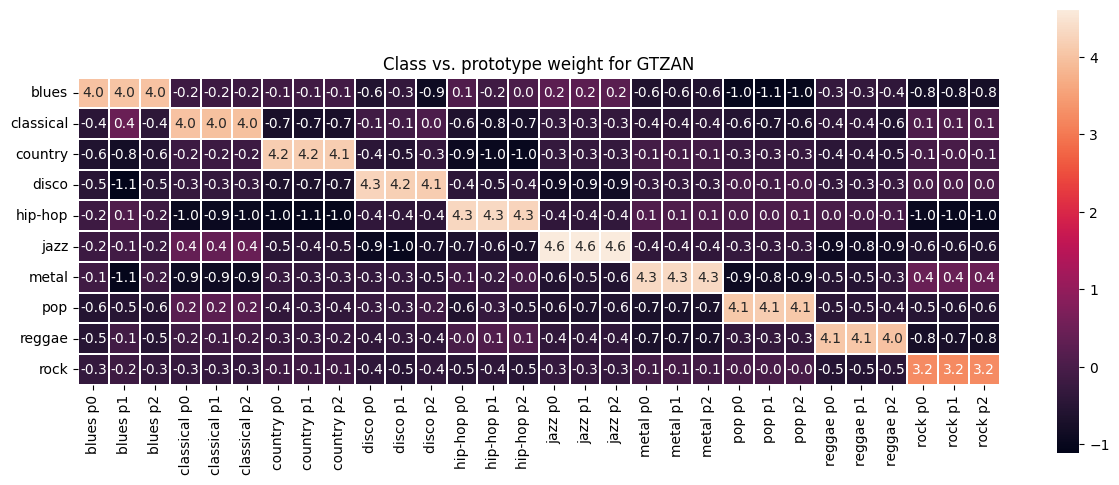
In PECMAE, prototypes are linearly connected to the classification layer.
The following plot shows the weights learned for these connections.
Certain prototypes have a slightly positive correlation with related classes.
For example, rock and metal.
10-second autoencoder
Results obtainer with an autoencoder with a 10-second context.
| class | PECMAE-5 (10s) |
|---|---|
| blues | |
| classical | |
| country | |
| disco | |
| hip-hop | |
| jazz | |
| metal | |
| pop | |
| reggae | |
| rock |